Tag Archives: health

Banishing Overwhelm

serated green leaves
motherwort leaves cut before flowering

This is no ordinary plant. You might say “well, Kirsti you think all plants are special,” and that’s true. But I have a real love affair going with this one.

Overwhelm is a real thing in our society. We all know the feeling of a too-long to-do list. And the overly full chest, overly heavy feeling that accompanies difficulty focusing in the face of a long list of tasks. And the anxiety that accompanies that has a way of setting in and staying.

Motherwort, pictured here, is widely used to truly calm that kind of anxiety in just such moments. A few drops of the tincture under the tongue definitely chases the feeling of overwhelm away. It’s legendary, used also in blood pressure remedies, to strengthen the cardiovascular system, and as support for premenstrual and menopause symptoms. If I had only known about it years ago, I could have eased many years of intense premenstrual cramps.

Just the other day I was out walking with a clinical herbalist, Stephan Brown, in his garden here on the cape. I’ve been taking motherwort tincture for months, originally to help with my blood pressure, I soon learned it benefits my mental state, as well.

But I have never seen the plant growing and I could not have identified it if it jumped up and slapped me in the head.

Knowing nothing about me or the remedies I favor, Stephan plucked a stem of motherwort from a nearby plant and presented it with a flourish. Herbalists and plants are both naturally psychic. There’s no getting around it.
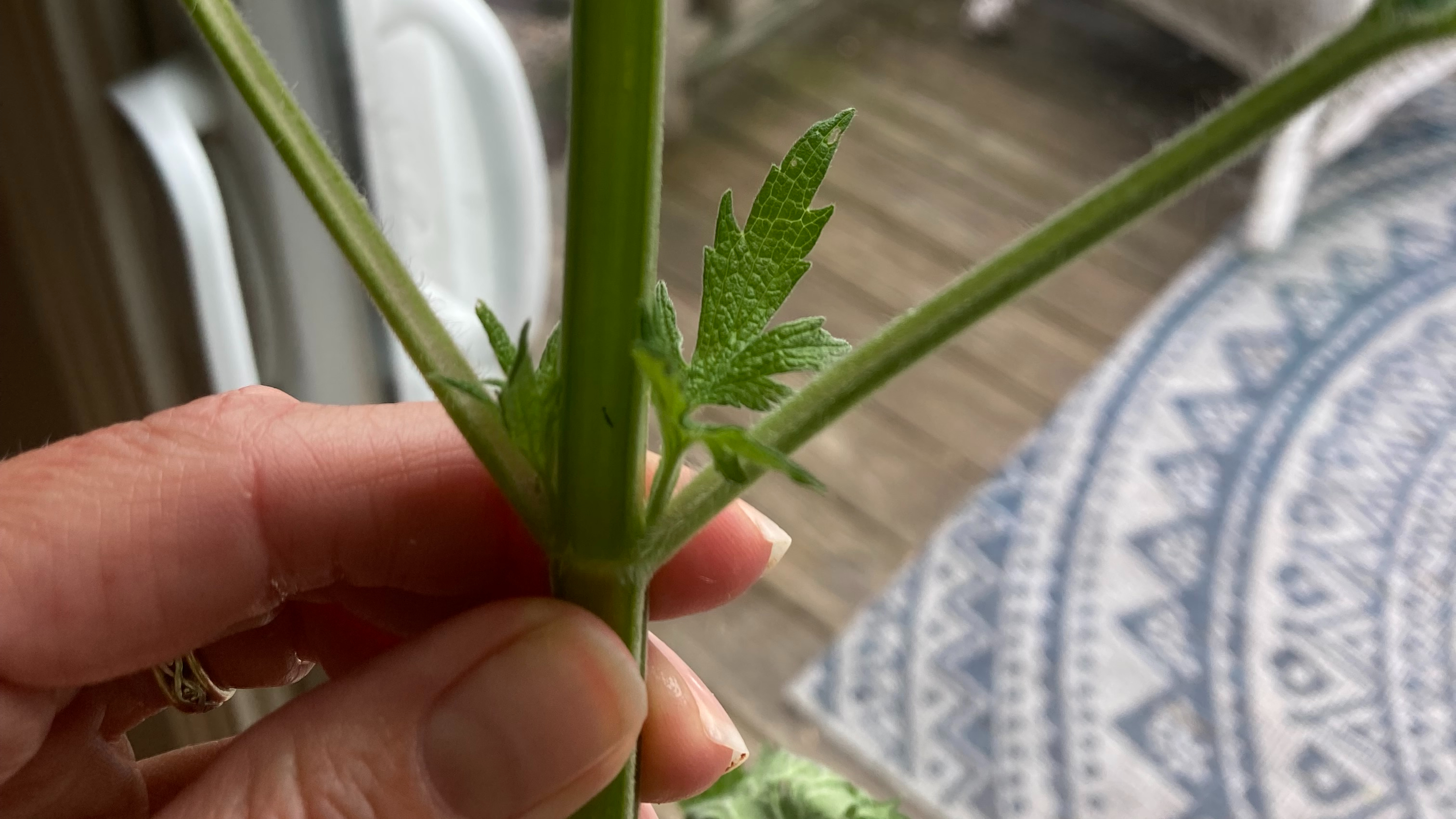
square stems of the lamiaceae; motherwort has an especially strong stem

I went back today to gather some with his permission. A member of the mint family with the characteristic square stem of that species, you can see the shape in the picture above, making it easy to identify.

The lovely leaves are drying now, which means I can make my own bottle of tincture. Pure magic.

Leave a comment

Filed under Uncategorized

Time Passes, Where There’s War and Where There Isn’t

With so much bad news all around us, especially in Gaza, before that Ukraine, and in the middle east for so long, it’s been challenging to focus on simple things, like a garden. To the point of it feeling irrelevant and even silly to focus on such an ordinary small thing. I’ve felt guilt at not making this horrible news more central in my life. And yet, I’m not there, there is little any of us can do beyond pray, sympathize, donate, commiserate. And this beautiful planet, devastated by the blasts just as her children (us humans, animals, plants- everything) are – suffers, too. So I do the things I can do, honor the life that arises here, and try not to let anxiety prevail.

So a story about time passing here.

My 19 year old daughter Inga got a summer job at a local med spa working the front desk. She started applying for summer jobs in April, interviewed remotely, and was offered this job before her final exams started. She was thrilled. She’d worked with the software they use and had done exactly this job last summer. She was especially happy because she wants to work as an injector when she finishes school, all goodness spring from beauty as it does 😉 and so a med spa would be good experience for her.

The night before her first day of work, which was scheduled for last week, she received an email from the med spa owner saying she’d given the position to someone else who can work year-round and that Inga didn’t “need to visit.” Inga hadn’t been aware they were (still) looking for someone for the job, or that they wanted a year round person. She was crushed.

I told her (in a more confident tone than I felt) that it was early enough in the season that she would find something else, and that she was better off. Who would want to work for someone that would behave that way, anyway? She saw the reason in my words and went back to job hunting. This went on for weeks and she had very few call backs and started to feel “helpless.” Most kids had secured summer jobs in April.

Then there was an offer to interview as … a jet ski guide. I laughed. Perfect for Inga who is spirited, athletic, and adventurous, and who has vowed in past summers to someday own a jetski because she thinks they are great fun. Yesterday she was offered the job with tips into the hundreds of dollars on the busiest (long) days… a small example of how sometimes things don’t go the way we hope, want, and expect them to, but somehow they work out.

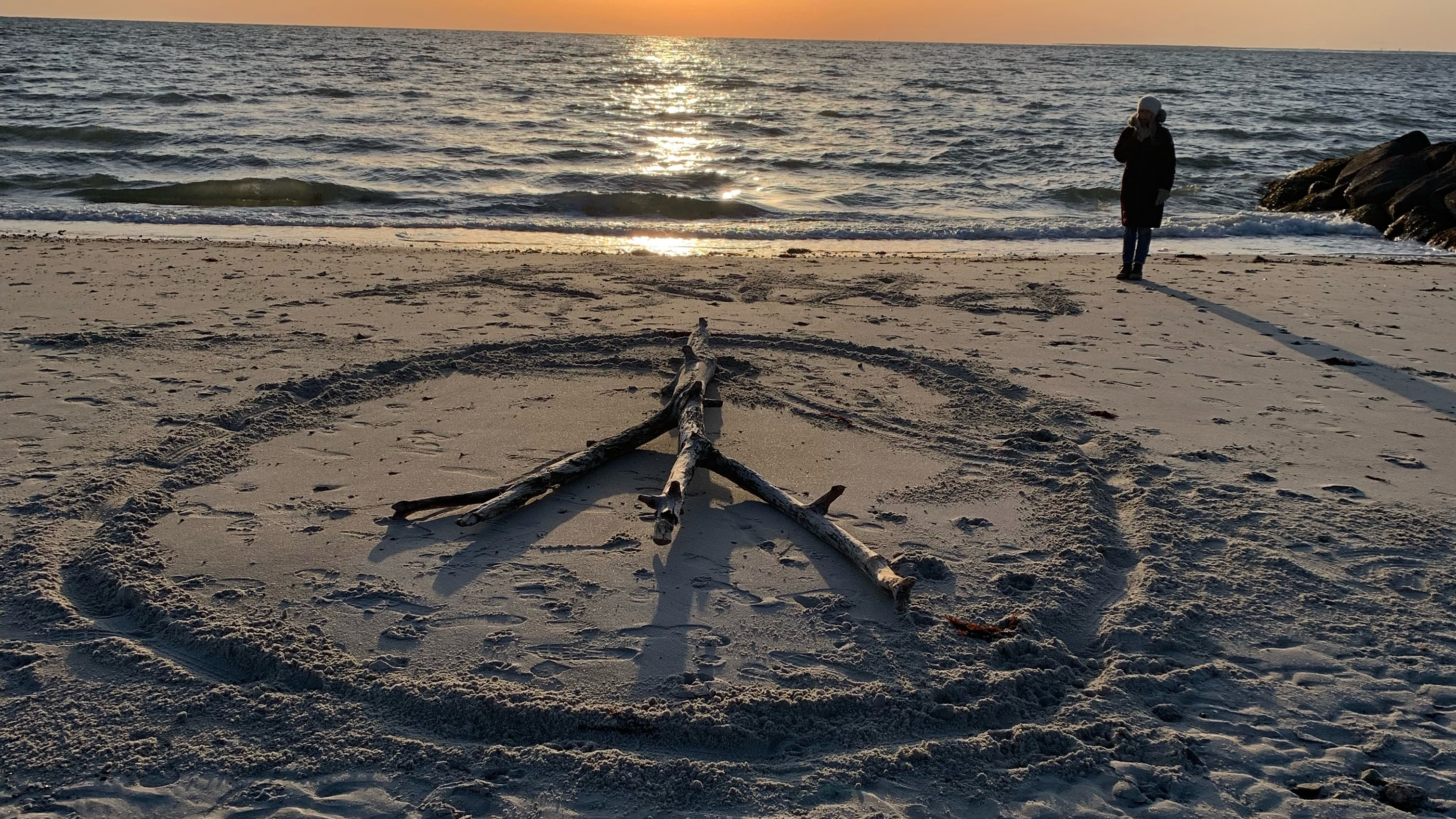
Inga last summer

And, returning to the garden.

I’ve been wandering out to my herb garden every day to see if I could spot a sign of my echinacea angustifolia. Echinacea A. is the variety of echinacea most prized for it’s infection fighting power. I’ve read it’s a little harder to cultivate than purpurea, which, admittedly, is usually pretty easy going. But there hasn’t been a sign of it germinating and I was beginning to think it won’t happen this year…

Until today!

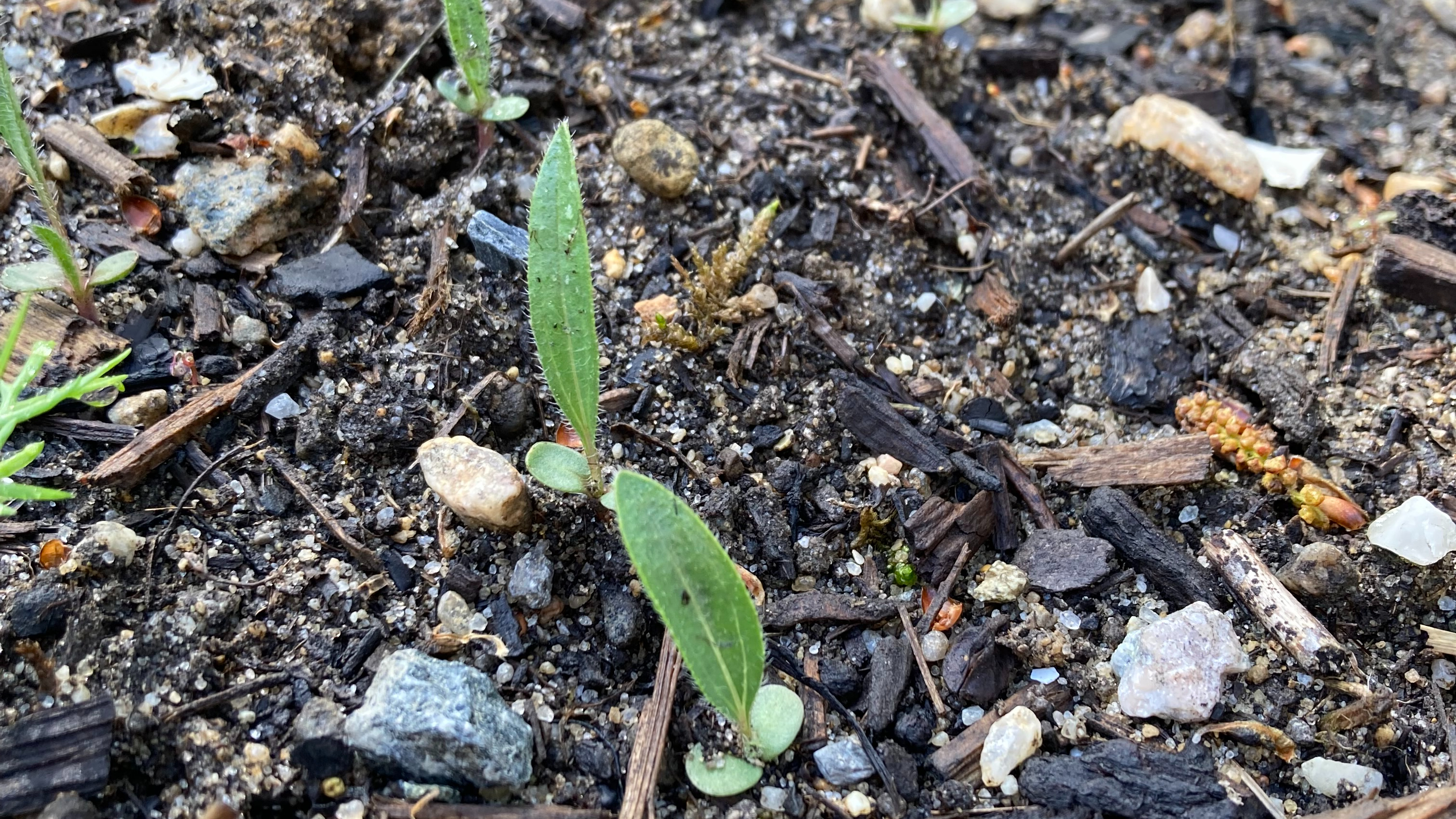
small green leaves emerging from dirt
tiny echinacea angustifolia seedling leaves poke up through the dirt

I hope and pray every day for things to come right, for healing, for the right outcomes, for people and planet to find balance, acceptance, equanimity, and well-being. May we all have a hand in creating peace and presence where and when we can, remembering to be. Not to be this or that. But just to be.

Leave a comment

Filed under Uncategorized

Powerful, Healing Goldenseal

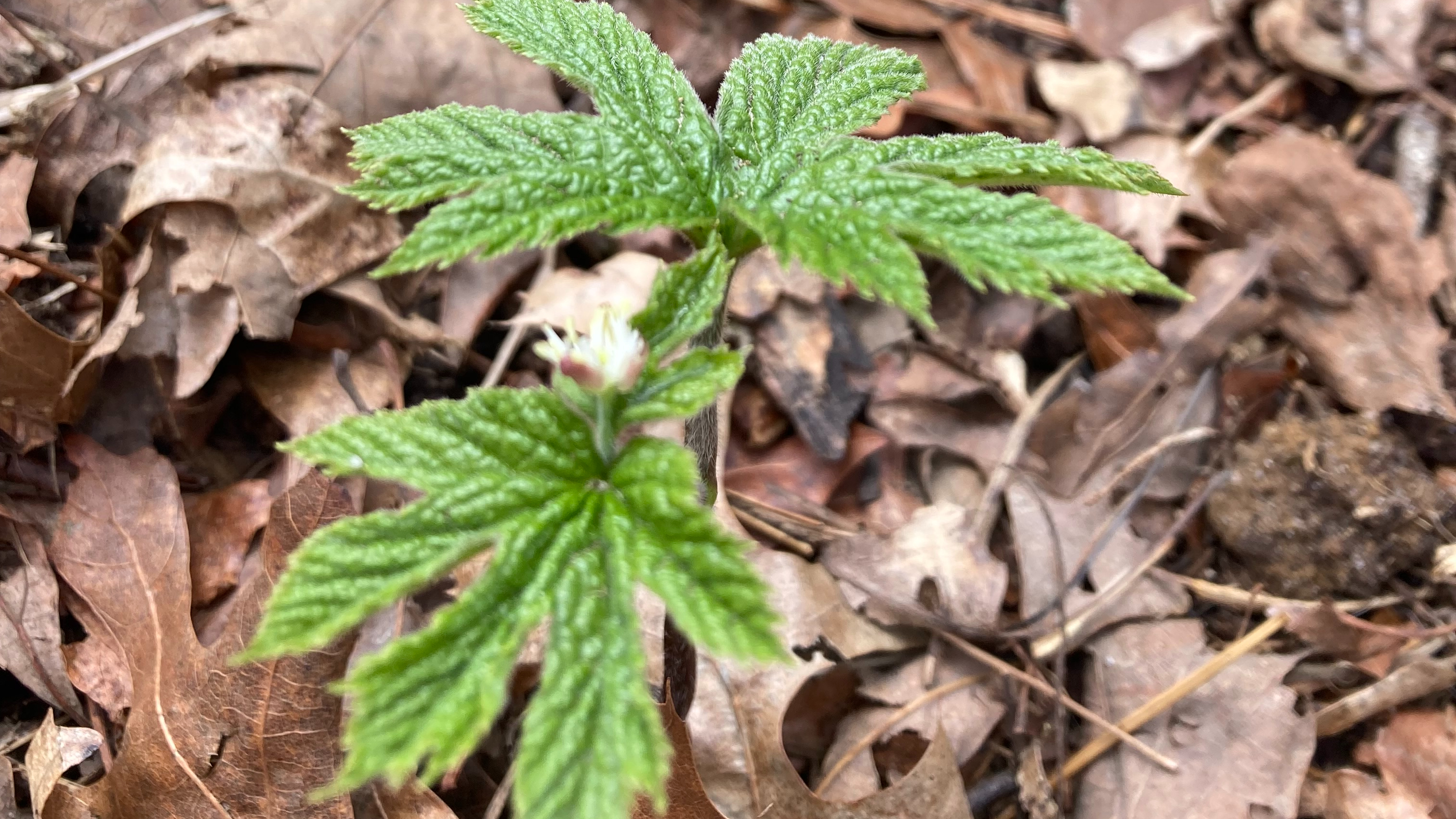
Two 7-leaved plants emerge from the brown leaves
Goldenseal root, Hydrastis Canadensis, is an herb endangered in North America from over harvesting, seen here emerging from the forest floor in spring

The beauty you see pictured here is Goldenseal Root. It’s the medicinal herb you often see in the herbal remedies aisle combined with echinacea in cold care formulas. Incredibly valuable medicine, it was popular with Native Americans on the East Coast of the US, and they taught us a lot of what we know about it.

My first experience with Goldenseal Root was when I was a young professional living in South Boston. I left work one Wednesday evening just before Christmas, trudged through the cold, damp winter air of Cambridge, and boarded the T to head back to my apartment – and specifically my bed – in South Boston, knowing I was getting sick. I could feel it coming on – chills, body aches, sore throat. An acquaintance at work, seeing my pasty pallor, instructed me to stop on my way home to buy echinacea and goldenseal root capsules. She swore by them and was sure it would be worth my time and money to stop at the coop for them. I took her advice, in part because I had a date the Friday following for a holiday party that I did not want to miss, and in part because I was willing to take anything that might help.

No sooner had I arrived home, herbs in hand, than the fever and chills overwhelmed me. I crawled into bed with my bottle of echinacea and goldenseal, only half believing they would help at all. I think I took between 8 and 10 of the capsules with water before falling asleep – more than the recommended dose.

All night long the fever and body aches raged, I alternated between sweats and chills. But, when I awoke the next morning, I felt miraculously better. The fever was gone.

I’d never recovered from a flu-type virus so quickly and I was convinced I was better because of the herbs.

Goldenseal contains infection-fighting alkaloids and bitters, and can be used internally or externally to fight infection. I use it in cold care capsules to fight bronchial congestion. It can be used in salves to fight skin infections, fungal infections, and athlete’s foot, in eye washes for conjunctivitis and eye infections, and as a remedy for poison ivy or poison oak.

The most potent medicine is in Goldenseal’s roots. Because this beautiful plant has so much healing power it’s been harvested in the wild to the point of becoming threatened.

Last year, I bought some of the roots from United Plant Savers, a group that is committed to preserving native North American medicinal plants, and planted them in a forested section of our backyard. No care, other than not trampeling over them or letting the chickens scratch them up (which, god bless them, they would) was taken with them. They emerged after spring rains quite independently.

Aside from wonder, the site of these baby healing plants unfurling their lovely glossy leaves evoked gratitude and deep relief. There’s hope for us, yet!

Leave a comment

Filed under Uncategorized

The Great “Why”

There’s a lot of talk lately in marketing circles about a person’s “why.” It’s about excavating a value statement – mainly to one’s self – for the work, sweat-equity, and energy we offer out in the world.

I’ve been meaning to get to this exercise – It was a part of my herbal course, they provided a worksheet meant to guide an exploration of one’s personal why. Why be a herbalist? Why create herbal remedies? For me, why garden, why plant seeds, why make formulas?

To connect. To heal.

I recently heard Jon Kabat Zinn say that his working definition of healing is acceptance of things as they are. I pondered. This is complicated. Sometimes we can heal by deciding to make things better: to take better care of ourselves, to find the ways and remedies that will bring healing. But, I suppose, we have to accept where we are first in order to do that. So his definition stands. At least from that perspective.

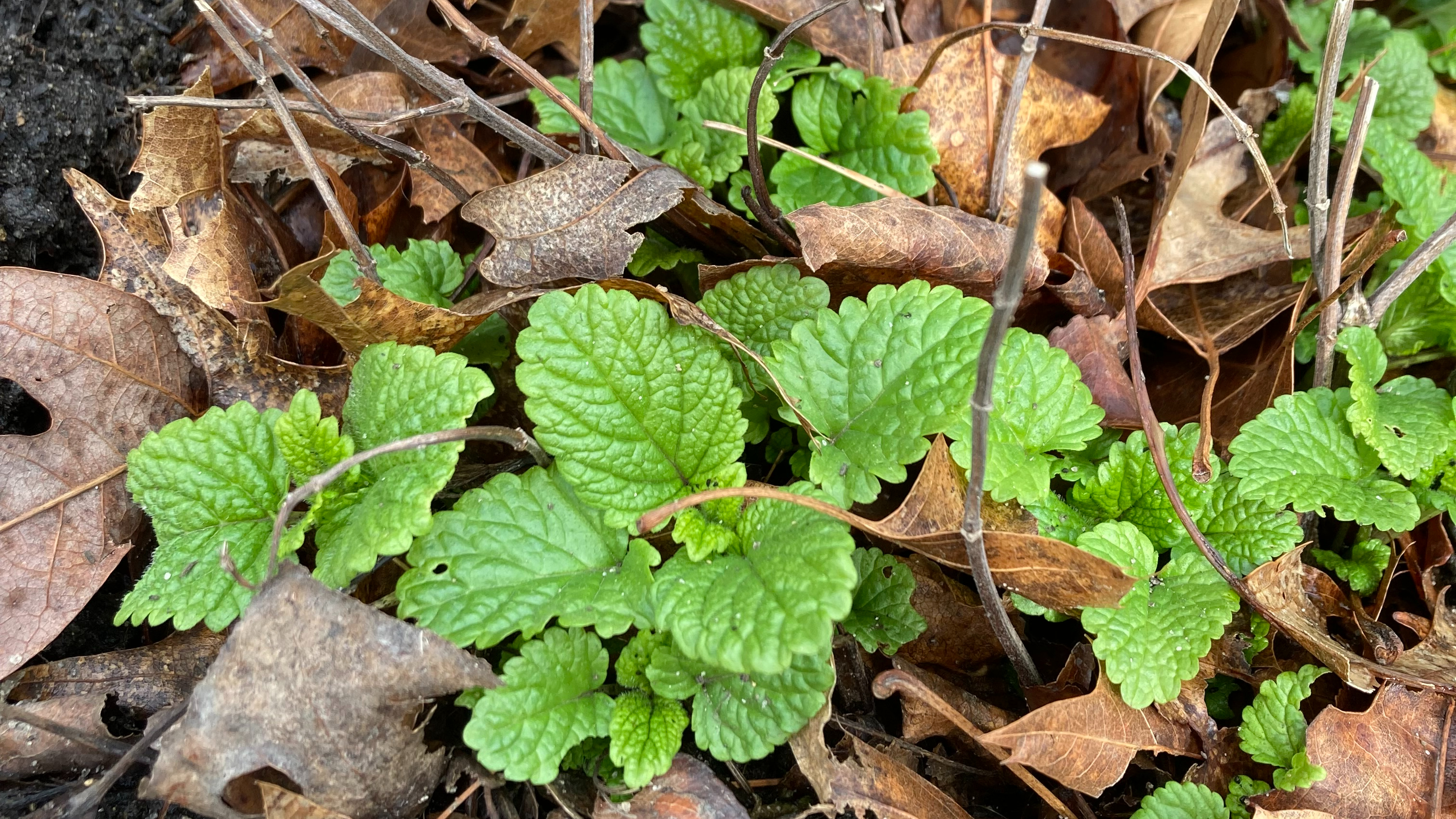
Lemon balm (above) is a nervine. It’s not as powerful, in my experience, as chamomile, but it has a very lovely calming effect and I know people that drink it as a evening tisane. Lemon balm, peppermint, chive, echinacea, oregano, sage, raspberry and violet seem to have followed me everywhere I’ve gone. I’ve dragged other friends – rosemary, thyme, basil, parsley, tulsi, borage, calendula, chamomile, lavender, hyssop, feverfew, savory, and a host of others with me, and I’m making friends with some other quiet classmates that I haven’t connected with before. Like Dandelion, plantain, and nettle. And there is a whole new class I’m joining of friends like motherwort, all heal, elecampagne, and others…

My why is us. Us and the plants. And our other sentient friends, the animals. Wild and companion. And bringing us together.

Leave a comment

Filed under Uncategorized

Herbal Remedy for Colitis/IBS/gut inflammation

Some time ago a friend approached me about his case of chronic colitis. Which is to say — he has had it for a long time and it’s pretty miserable, and did I have any suggestions?

Off the top of my head, other than demulcents, which are mucilaginous herbs that coat and soothe inflamed or irritated membranes, I did not. But I did a bit of reading and found that there is an herbal formula that has been used for IBS and similar problems related to the digestive system for a long time with good results, and has been adapted for use with modern constituent derivatives, etc. Looking at the ingredients list, it seemed to me that the formula addresses inflammation and virus in the gut. None of the ingredients had contra-indications that discouraged me, though these are definitely medicinal, rather than tonic herbs. By that I mean that these herbs are known to have powerful and immediate effects, as opposed to herbs that are gentler and can be taken daily and indefinitely. 

I decided to make the traditional formula myself and share it with him. 

There are versions of the formula that can be purchased online and have been modified from the traditional version by their makers, but I found an “original” formula that did not include derivative compounds, and purchased those herbs.

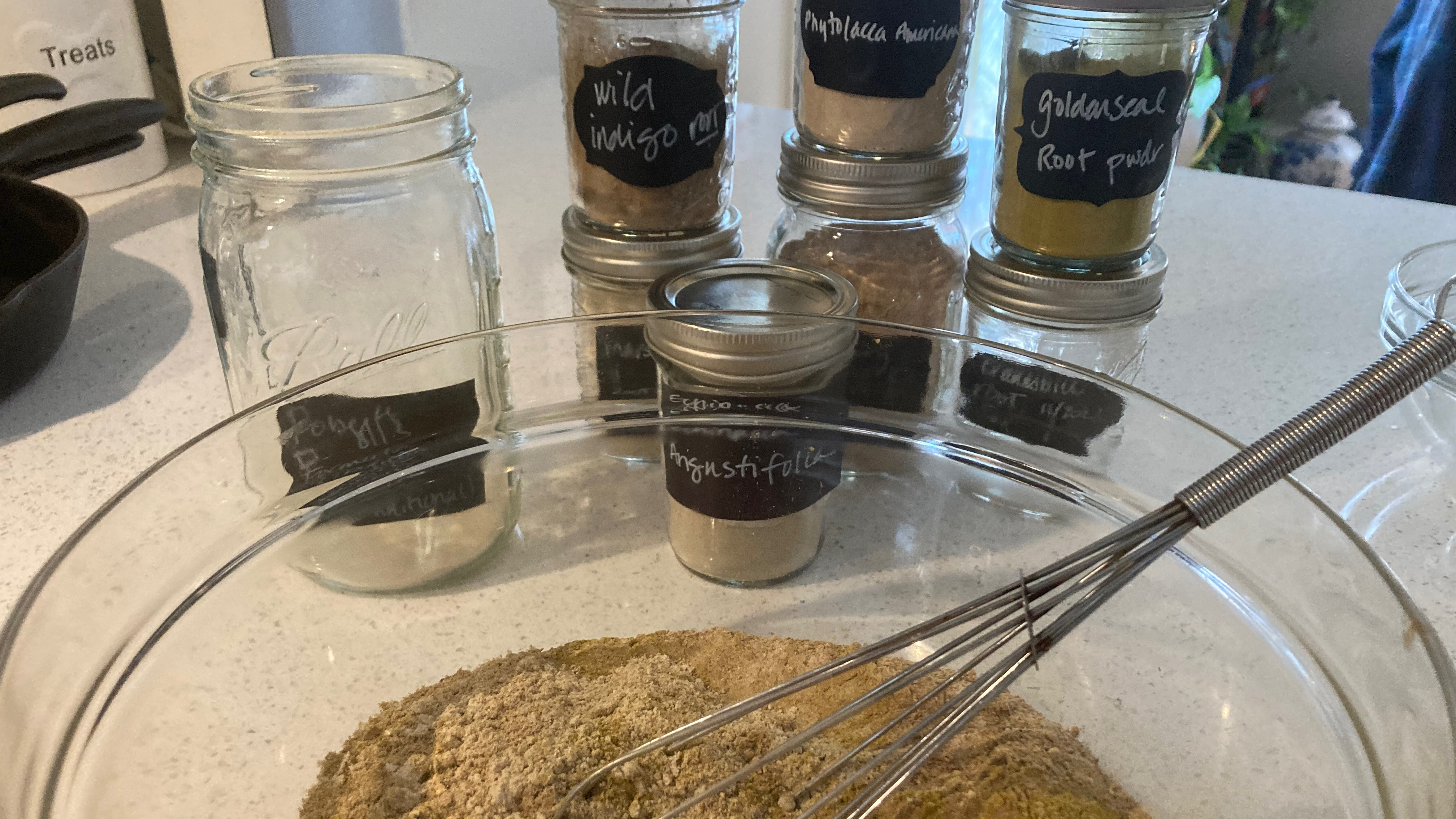
a mixing bowl of herbs flanked by jars of each type that appear in the bowl.
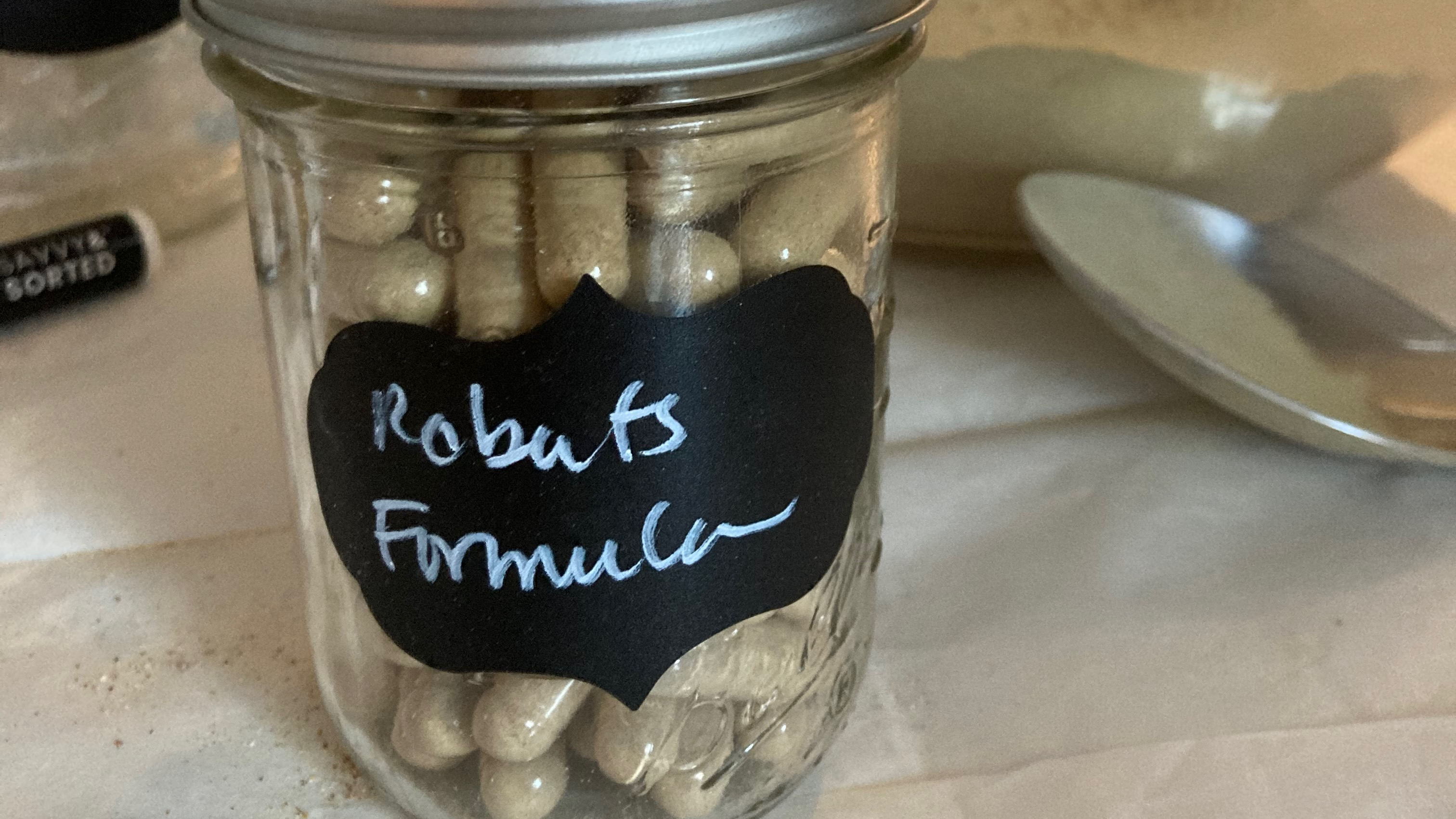
the individual ingredients in Roberts formula pictured here and combined at front in a mixing bowl before encapsulating

I will give away the ending before continuing this story: this formula worked for him. It corrected a chronic and persistent case of colitis that had been present for over a decade in a matter of weeks. 

encapsulating Robert’s Forumula

When the herbs arrived I had to grind some in order to be able to compound them, so I spent a Saturday morning grinding and combining them in equal parts. The old formula did not specify the quantity or ratio of each herb. I know from my herbal studies that often we combine in equal parts unless we know an herb (like cayenne or in goldenseal, for example) should be used more sparingly. I made the decision to combine them in equal parts.

The ingredients in the formula I made: Purple Coneflower root (Echinacea angustifolia), Marshmallow Root (Althaea officinalis), Wild Indigo Root (Baptisia tinctoria. note here the original called for a different genus – Baptisia australis, but the tinctoria was available and I judged the substitution to be fine), Slippery Elm Bark (Ulmus rubra), Poke Root (Phytolacca americana), American Cranesbill Root (Geranium maculatum), Goldenseal Root (Hydrastis canadensis. A note, this is an endangered species at this time so I was careful to order it organically cultivated. Please don’t buy this wildcrafted.)

We know that herbs are the original medicine of the people, and that they are powerful and effective, but I was surprised at how quickly and effectively this formula worked because traditional allopathic medicine had tried and failed to treat him. The truth is that allopathic medicine often is more quickly effective for some things – for killing pain, for example. But in this case these herbs, which are whole foods, worked with his body to remedy a problem that had been serious and persistent for many years, and had not been treatable with allopathic medicine.

Some of the versions of this formula you can buy are liquid and arguably more easily absorbed. I felt that in this person’s case the ease of the capsules would help ensure he’d take them, and the pure nature of the herbs compounded together with no “carrier” ingredients (tincture or syrup) felt intuitively right and was more accessible to me. 

If you have questions about this please feel free to reach out to me. I’m not a doctor, just a simpler herbalist, but I felt sharing this was important because of the profound effect it had for my friend , and I know that many people have similar digestive problems. 

Wishing you wellness.

Finished Roberts Formula capsules

Leave a comment

Filed under Uncategorized

Flow and Adapt

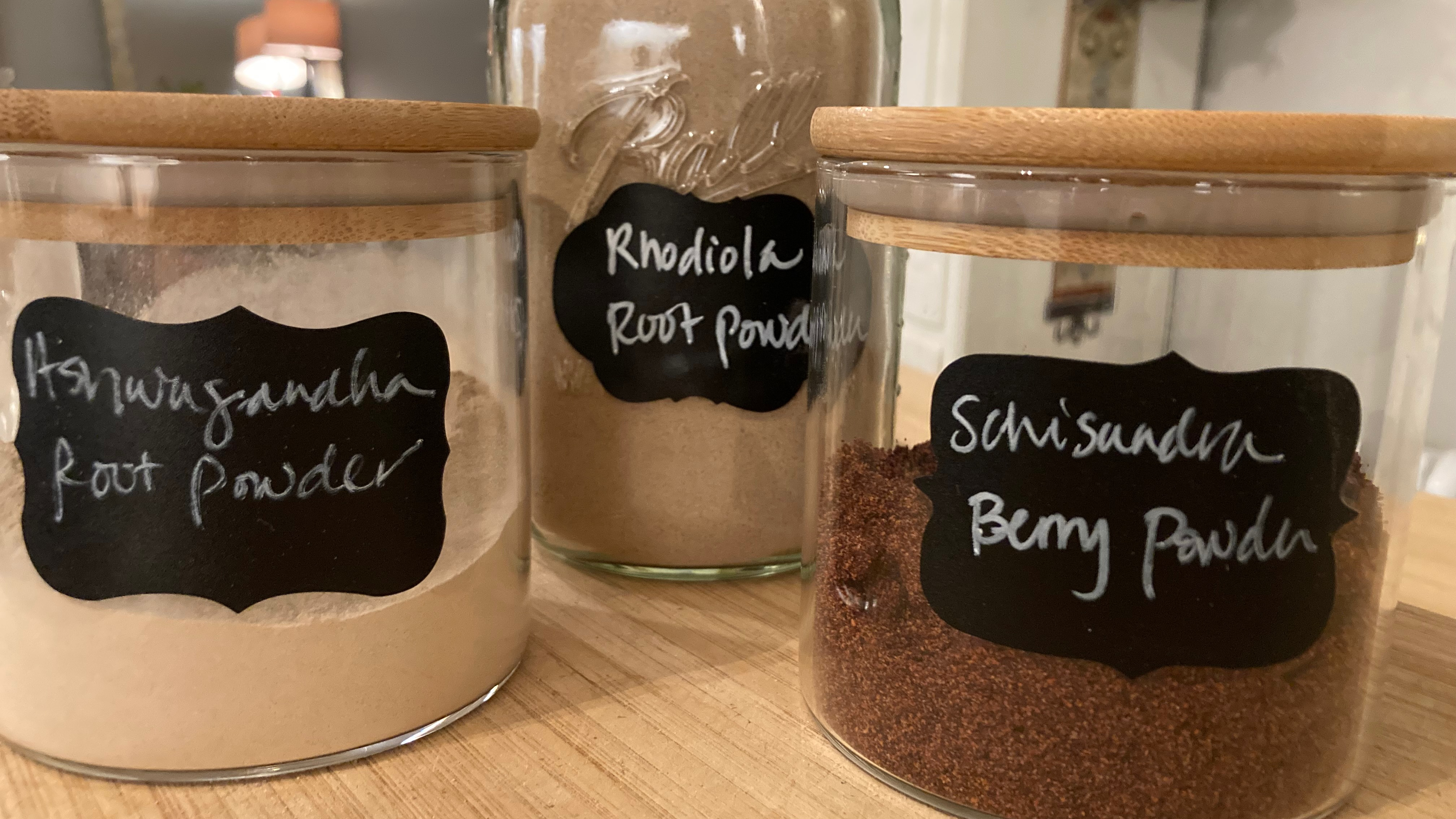
Ashwagandha, Rhodiola root, and Schisandra Berry powders

My son decided to drop out of his college program with approximately one year remaining. He has practical reasons for this, but also, he was stressed out and his health wasn’t benefiting from the lifestyle and pressure he had. One way he chose to address the stress was to buy a bottle of “adaptogens” – capsules filled with Ashwagandha, Rhodiola root, and Schisandra berry. Most of us have heard of adaptogens – plants that help us manage and recover from stress – and Tristan found them to be very useful to him as he tried to balance his full-time course load with a new business that he was trying to get off the ground.  

In my studies, I’ve learned that some producers are sourcing their plant material unethically – many are, in fact – and so I suggested he allow me to make capsules with the same adaptogens in them. This way I was able to ensure the herbs are sourced ethically, which is important to me.

As so often happens, the universe was presenting me with a prompt; I would really benefit from taking adaptogens in, as well! One of my key aims is finding flow during my day. Being “in flow” comes with focus, intention, even meditation, and having a bit of support from one’s parasympathetic nervous system is a like riding a beneficial tide in the right direction! When we are in flow we are channeling creative energy, intuition, and doing our best work.

Along with the bumps, periodic grief and loss, and stresses of life, most of us (myself included) are at least a little overloaded (even strung out) on information overload and the pace of modern living. So engaging a parasympathetic nervous state is seriously helpful to most of us. A few adaptogenic herbal friends that can help with that:

Ashwagandha (withania somnifera) is traditionally an ayurvedic herb, and is a thyroid adaptogen. Not great if you have a hyperthyroid, It stimulates the thyroid, affecting and regulating the adrenals, and increases thyroid hormones that circulate through the body. It’s also anti-inflammatory. It’s beneficial for fatigue and insomnia, encouraging deeper, restorative sleep.

Rhodiola (Rhodiola rosea) has also been used for centuries – since at least 1100 AD – in Scandinavia and Russia, where it thrives in cold climates. It’s root is an adaptogen, containing more than 140 active ingredients, and is used to treat anxiety, fatigue, and depression. It is known to support the immune system, and protect against infection and flu.

Schisandra (schisandra chinensis) is native to asia, an antioxidant known to support endurance and resilience, and protective to the liver. It aids the body in returning to a parasympathetic state, helping to manage stress reactions.

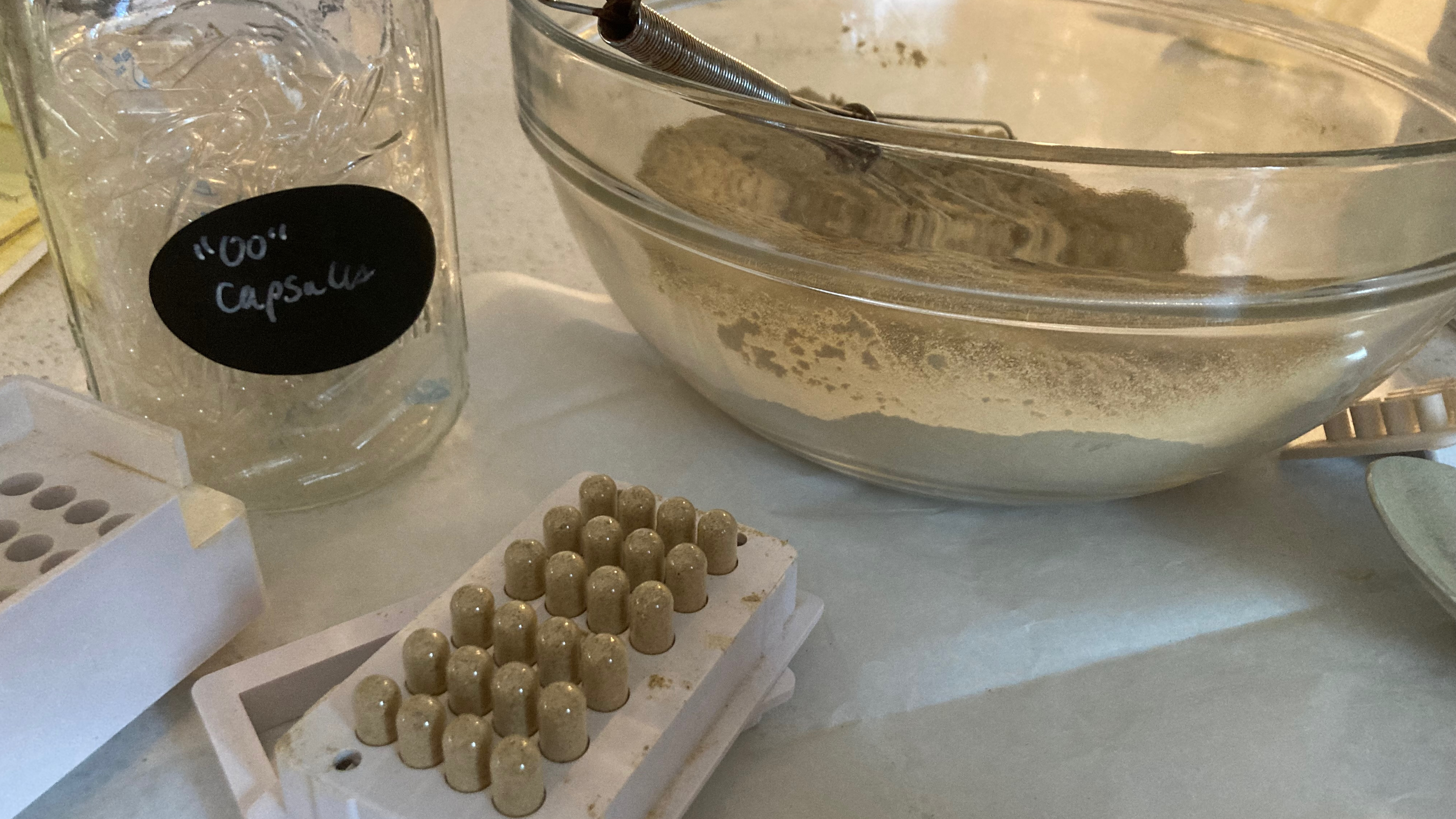
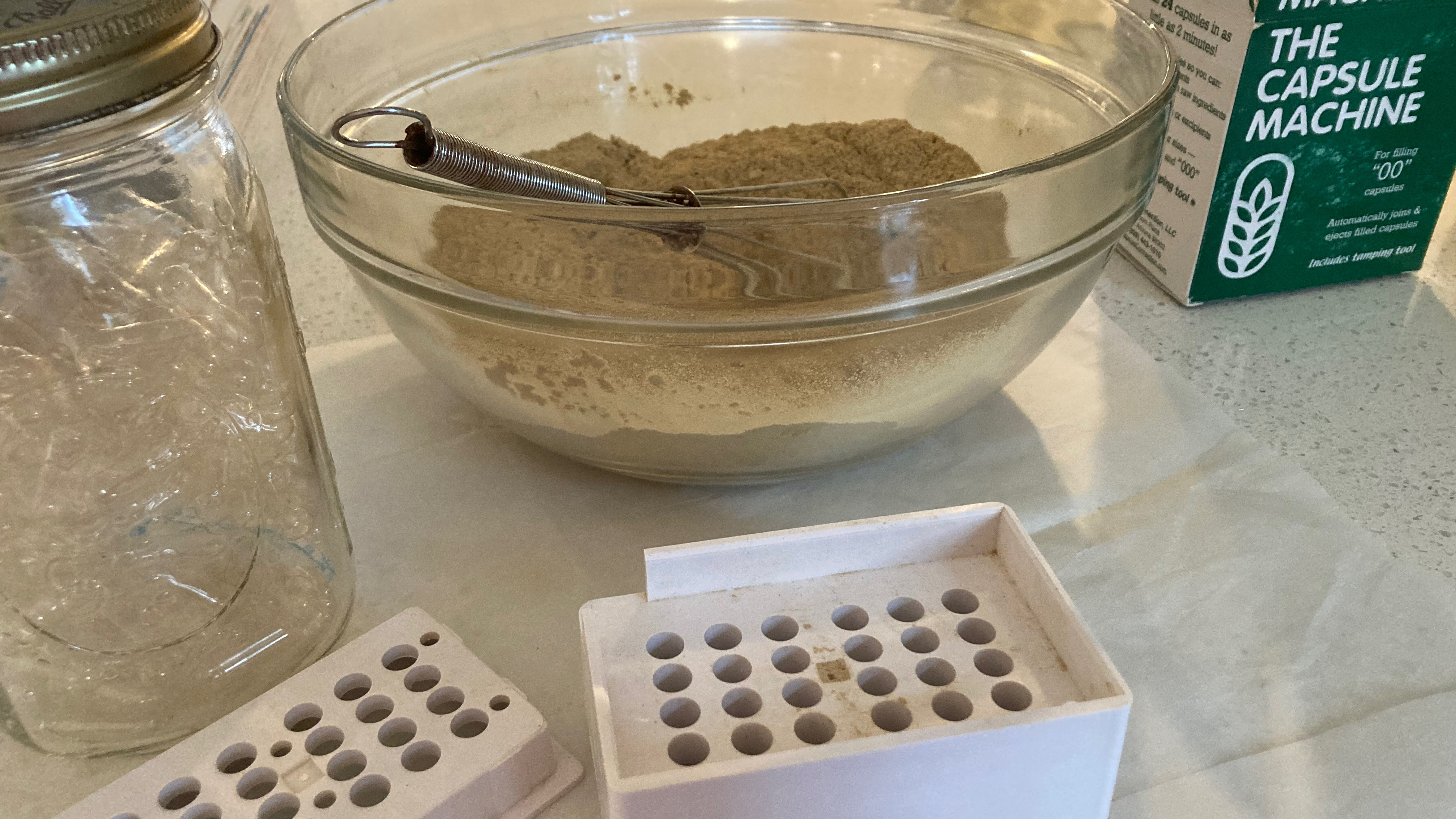
image of capsule machine, mixed ashwagandha, shisandra berry and rhodiola root

There are many adaptogens out there – these are just three that have become popular and have long histories of use.

While you can buy adaptogens in capsules and gummies at pharmacies, it’s not hard to make capsules. This capsule machine and gelatin capsules are readily available to buy online and you can buy powdered herbs from ethical suppliers like Mountain Rose Herbs online.

Wishing you flow, peace, and fun during these lengthening winter days.

Leave a comment

Filed under Herbs and Healing, Uncategorized

On Cholesterol, or No One Really Likes Statins Do They?

Over the years it seems like I’ve heard about cholesterol continually. My first husband was always avoiding eggs and butter because cholesterol ran in his family, and my current husband Jon is locked in mortal battle with the matter of whether to take statins, which give him muscle weakness.

Historically I’ve avoided medical literature because … well, it’s pretty dry. Recently, though, I sat down and read about cholesterol because I want to help Jon deal with it. I’m an herbalist and feel confident that if I help him modify his diet and supplement with supportive herbs and relevant lifestyle changes we can ward off his doctor’s requests that he take statins. The proof will be in the pudding of his next cholesterol screening, but in the meantime we’re on this train. 

So, here’s what I learned about cholesterol, which turns out to have an actual purpose in our bodies:

“Stress, toxins, alcohol, and many other substances create free radicals in the body by catabolizing (breaking down) oxygen molecules into reactive oxygen species, which are single atoms of oxygen that have extra “unpaired” electrons.  These “excited” electrons cleave onto other electrons in body tissues and walls of arteries, creating micro-wounds.  This is the same process that causes metal to rust – aka oxidation…

… In order to repair damaged tissue, hormones signal the liver to release cholesterol, which is a life-saving endogenous antioxidant.  Cholesterol repairs the wound. But when this type of oxidation is continual, day in and day out, the excessive wounding creates an immune response, which generates more tissue irritability and more cholesterol, and that builds up into plaque…

Paradoxically, “… the discovery of cholesterol plaque build up in arteries led to a misconception that high cholesterol is a cause of heart disease.  In fact, one cause of heart disease is the inflammation that triggers the release of cholesterol…”  (Maier, from Energetic Herbalism)

So, cholesterol serves a function in the body – it tries to protect the heart. And, heat and inflammation are healed by cholesterol.  We are treating elevated cholesterol levels with statins, but we aren’t treating heat and inflammation with them. So we’re treating a symptom, not the cause of the problem.

… And statins can cause liver damage and the breakdown of muscle tissue.  Maier says it is important to check liver function every 3-6 months when taking statins.  I’ll ask if liver function tests have come up during Jon’s odyssey with statins – he hasn’t mentioned it.

So what are the recommendations for lowering cholesterol production/reduction of inflammation and heat of oxidation?

  • Lower Sugar Intake – sugar causes cell to make its own cholesterol, which isn’t taken up and contributes to ldl levels.   (it’s such a bummer about sugar. it’s so tasty)
  • Consume antioxidants: red, blue, and purple berries, including aronia berries, blueberries, pomegranates, elderberries, and dark green vegetables
  • Sedative sour herbs: sumac (Rhus spp) and hibiscus help clear inflammation, also Roselle (H. Sabdariffa) has antioxidant effects, esp related to cholesterol.
  • 1 clove of garlic daily 
  • 25 g of oatbran on breakfast cereal
  • 1-2 tsp of oolong (especially Pu erh tea/day  (from Ody, Complete Medicinal Herbal)
  • Oyster mushrooms seem to have a cholesterol-lowering affect: https://www.sciencedirect.com/science/article/abs/pii/S1756464610000630)

Some other interesting things to know about cholesterol and how it functions in your body:

  • Production of sex hormones, adrenal hormones including cortisol, corticosterone, and aldosterone
  • Production of bile
  • Necessary for production of vitamin D in the body
  • Important for the metabolism of fat-soluble vitamins
  • Insulating material for nerve fibers
  • Regulation of serotonin
  • Maintenance of cell membrane permeability
  • Essential role in preservation of memory

And about Red yeast rice extract - it is made from fermentation of rice with Monascus purpureus yeast.  This is the substance statin drugs have been produced from and is as effective as statins but takes longer (~6 months) to have an effect on cholesterol levels and must be taken with CoQ10.  CoQ10 is a hormone (called ubiquonone) which is found in every cell of the body and is stored in the mitochondria (organelles that power our cells). It also acts as an antioxidant.  Statins cause so much damage because they severely diminish natural production of CoQ10.  Red yeast rice does, too, but at a much lower rate. 

It’s important to know that red yeast rices is a symptomatic treatment in that is lowers cholesterol levels but is does not treat inflammation, which is the cause of the elevated cholesterol production.  (above from Maier, Energetic Herbalism)

Leave a comment

Filed under Uncategorized